


The Drukpa Lineage
 The lineage acquired the name Drukpa in the twelfth century when, assuming the human form, Avalokiteshvara - the Great Lord of Universal Compassion - manifested in Tibet as the outstanding disciple of Mahasiddha Lingchen Repa. This sublime being was called Drogon Tsangpa Gyare, the meaning being: Drogon - the Protector of Beings; Tsang - born in the land of Tsang; Gya - from the noble clan of Chinese (Gya) origin; Re - a cotton-clad yogi.
"Druk" in Tibetan means "Dragon" and it also refers to the sound of thunder. In 1206, exactly 1,000 years ago, Tsangpa Gyare Yeshe Dorje saw nine dragons flew up into the sky from the ground of Namdruk, and he named his lineage "Drukpa" or "lineage of the Dragons" after this auspicious event. In this way, Tsangpa Gyare became the founder of the lineage and was known as the First Gyalwang Drukpa.
Tsangpa Gyare was prophesized in many Sutras and Tantras and was recognized as the indisputable emanation of Naropa (1016-1100). In the Fundamental Tantra of Manjushri (Toh. 543), Buddha Shakyamuni spoke of the coming of Tsangpa Gyare:
Three thousands years after my nirvana,
Sonam Nyingpo will appear,
in his future incarnation in the land of snows.
He will be born in the Hwashang (Chinese) race
and given the name Gelong Yeshe Dorje.
He will renounce worldly existence
and voluntarily embrace the essential meaning.
He will establish sentient beings in liberation,
and while abiding in the essence free from the two extremes,
he will flourish my doctrine.
 Tsangpa Gyare's great great grandfather was one of the two strong Chinese men who were selected to pull the royal chariot that carried the precious statue of Jowo Shakyamuni to Tibet when Chinese Princess Wencheng of the T'ang Dynasty married the famous Tibetan King Songtsen Gampo (617-650). In the early part of his life, Tsangpa Gyare was called 'Gyaton' which literally means 'Chinese teacher'.
In his life, Tsangpa Gyare unveiled many treasures of holy teachings and objects in Southern Tibet, and he also discovered Tsari, a very famous, holy and powerful place in Tibet. Because of his spiritual attainments, Tsangpa Gyare became popular as Druk Tamchay Khyenpa, the Omniscient Dragon, and reverentially called 'Je Drukpa' (Lord Dragon master). He was a famous teacher whose teachings were sometimes attended by as many as 50,000 people at any one time. It was recorded that he had 88,000 eminent followers, of whom 28,000 were enlightened yogis. His order became famous for the purity, simplicity and asceticism of its adherents and the profundity of its spiritual teachings. He wrote a renowned commentary on the Tantra of Chakrasamvara and taught widely.
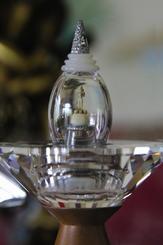
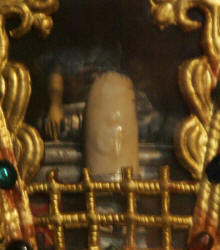 When Tsangpa Gyare passed away in 1211, on the cremation day, a rainbow canopy appeared and showers of flowers fell. Many could hear celestial music and smell a beautiful aroma in the atmosphere. When his body was cremated, his heart, tongue and eyes remained intact. His skull bore the images of Arya Avalokiteshvara, Manjushri and Vajrapani; the twenty-one joints of his backbone turned into twenty-one mini statues of Avalokiteshvara. Many of these relics are still available in various Drukpa monasteries for reverence and these are proofs of Tsangpa Gyare's spiritual attainments.
The Kingdom of Bhutan, considered as one of the few remaining Buddhist kingdoms in this world and a pure land in the Himalayas, also takes the name of "Druk" or "Druk Yul", meaning "the Land of the Thunder Dragons" and its people are also known as "Drukpa". This is because in the 17th century, one of Tsangpa Gyare's fourth incarnations, Shabdrung Ngawang Namgyal (1594-1651), united the warring regions in Bhutan and became the political and religious leader there. During his reign he was responsible for the construction of many fortress palaces and monasteries as well as devising many of Bhutan's customs, traditions and ceremonies. This forged a unique cultural identity distinct from Tibet.
Vajradhara
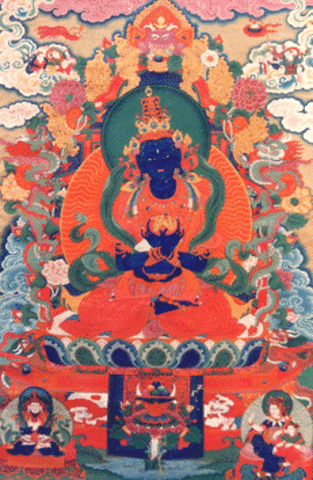 Vajradhara is the primordial Buddha, the embodiment of all the Buddhas of the three time periods, and the essence of the three kayas or bodies of the Buddha. Vajradhara also represents the Dharmakaya Buddha and therefore, the ultimate aspect of Enlightenment.
The Drukpa lineage traces the origin of its transmission to Vajradhara as he is truly the manifestation of the supreme essence of Buddhahood. With his right hand holding the dorje (symbolizing "method"), his left hand holding the bell (symbolizing wisdom), and the two crossed over his chest, Vajradhara is the ultimate representation of non-duality and emptiness, which is indeed the "Mahamudra", the Great Union - the ultimate realization sought by all practitioners of the Drukpa lineage.
Tilopa (988-1069)
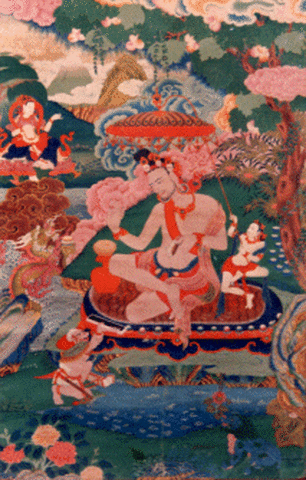 Tilopa was born in a Brahmin family in East Bengal, India. When he was still a young shepherd, he met the great Bodhisattva Nagarjuna who gave him preliminary teachings on the Mahayana path and appointed him as the ruler of a kingdom in Bhalenta. After a number of years leading a luxurious royal life, Tilopa decided to renounce the kingdom and become a monk. He took his ordination vows at the Tantric Temple of Somapuri in Bengal and started his monastic training.
Thereafter, Tilopa had a vision of a dakini guiding him on the direct and esoteric path of Enlightenment. From the dakini, Tilopa received the entire transmission of the Chakrasamvara Tantra.
Tilopa also received several teachings and transmissions from great tantric masters such as the learned translator Acharya Charyawa and the siddha Lawapa. From these gurus, he mastered the instruction and practice of Bardo (the intermediate state between death and rebirth), Phowa (the transfer of consciousness), Tummo (the practice of inner incandescence), and many other oral-pith instructions. Although Tilopa had several enlightened human masters, his root guru was Buddha Vajradhara who directly transmitted to Tilopa many esoteric teachings, including the practice of Mahamudra.
For 12 years, Tilopa was devoted to the practice of these teachings, and he took a yogini as his secret consort. The monastic order immediately expelled him due to his involvement with the yogini. Tilopa led the rest of his life in solitude, but he was a renowned great master. Amongst his disciples, Naropa was the one chosen to continue his lineage.
Naropa (1016-1100)
 The great siddha Naropa was born to a royal family in Bengal, India. His yearning for spiritual development was so strong that at age eight, he journeyed to Kashmir to study with the master Arya Akasha and received the lay ordination.
When Naropa returned from his spiritual and intellectual pursuits, he was forced by his parents to marry a Brahmin princess. However, the marriage only lasted for eight years. Naropa unveiled his spiritual goal to his wife and she decided not to be a hindrance on his path.
Naropa took the vows of a novice monk at the Happy Garden Monastery and was subsequently fully ordained in Kashmir. Thereafter, he stayed in Pullahari Monastery to continue his learning and practice, and received further teachings and training at the nearby University of Nalanda.
Naropa's wisdom, oratory skills and spiritual understanding earned him the chancellorship of the famed University of Nalanda where he also became the Northern Gatekeeper. He was constantly faced with difficult debates with the heretics, but he was regularly victorious.
Although Naropa was well-versed in the theoretical aspects of Buddhism, he realized that he was still inept in the training of his restless mind. A dakini thus appeared before him, explaining the importance of meditation, and advised him to seek the guidance of Tilopa, a great master who could lead him to realize the ultimate nature of the mind.
 Traveling eastward, Naropa finally met his destined root guru, Tilopa, who instantly put him to difficult tests. Naropa experienced 12 major and 12 lesser hardships so as to purify his karma and emotion-induced obscurations. Through receiving great blessings from Tilopa and accomplishing his own purification, Naropa realized the clarity and harmony of mind, truly experiencing the state of Vajradhara. After attaining this magnificent realization, Naropa taught in many places and had numerous disciples, especially in Kashmir where many monasteries were established by Naropa himself. Tilopa and Naropa were both recognized as two of the 84 great mahasiddhas in the history of Buddhism.
Amongst Naropa's accomplished disciples was Marpa, the translator, who succeeded Naropa in the lineage and brought the entire teachings and transmissions to Tibet.
Marpa (1012-1096)
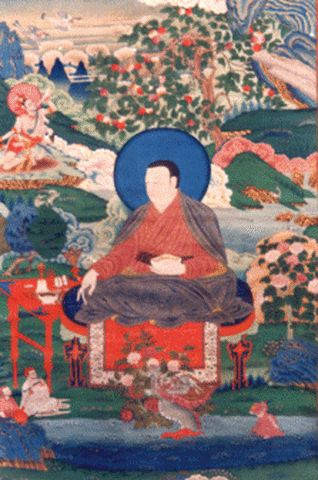 Marpa was born in Chukhyer in southern Tibet. From the Sakyapa lama Drogmi Lotsawa he learned Sanskrit and received a few teachings. Dissatisfied with his learning progress, Marpa decided to trade all of his possessions for gold to travel to India in order to receive more teachings, and to bring them back to Tibet.
It was during his trip to India through Nepal that Marpa met two of Naropa's disciples, Kantapa and Pentapa, and received teachings from them. Marpa was so impressed by them that he decided to meet Naropa in person to receive direct instructions. For many years, Marpa studied under the guidance of Naropa. He received teachings during the day, and practiced with one-pointed devotion during the night, mastering the theoretical and practical aspects of Mahayana and Vajrayana. Naropa eventually appointed Marpa as his successor in Tibet, and prophesied that his lineage would prosper considerably in the Land of Snow.
Marpa made repeated trips to India and Nepal, brought many teachings back to Tibet, and translated them from Sanskrit to Tibetan for the benefit of the people of Tibet. He underwent several hardships, and almost lost his life during the arduous journey to seek the Dharma. He met many masters, but Naropa and Maitripa were the most important amongst all.
Although Marpa was married with wife and children, his realization was incomparable and was likened to a lotus in the mud, free from defilements. To him, samsara and enlightenment were inseparable, and all worldly phenomena were no different from Buddha nature. Therefore, he could lead a conventional samsaric life and remain unstained. Marpa truly attained the state of Vajradhara, or Buddhahood, in one lifetime.
Marpa translated many Mahamudra and Vajrayana teachings into Tibetan and taught widely. His disciple Milarepa was selected to continue the lineage.
Milarepa (1052-1135)
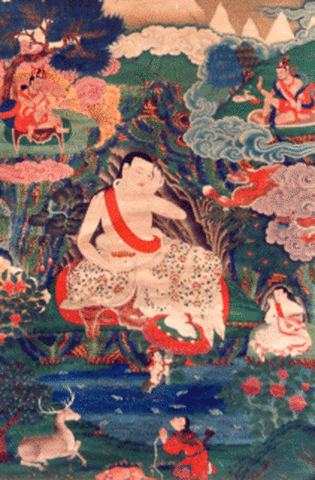 The great yogi Milarepa was born in the province of Gungthang in western Tibet, as the son of the wealthy landlord, Mila Sherab Gyaltsen. But at age seven, Milarepa's father contracted a deadly disease and passed away after entrusting all the family's possessions to Milarepa's aunt and uncle who were asked to take care of the widow and children, and to return these properties to Milarepa and his sister when Milarepa reached majority.
However, upon his father's death, Milarepa's vicious aunt and uncle took control of the property, and made his mother, sister and himself work as slaves on the farm, without any compensation. As Milarepa approached adulthood, not only did his aunt and uncle deny his rights to the property, they claimed that these properties were repayment of debts owed by Milarepa's late father. Outraged and humiliated, Milarepa's mother sent him to learn powerful black magic to punish the traitors.
Milarepa soon mastered the dark power of destruction and killed many innocent people in his vengeful acts. The regret and remorse he felt after all these misdeeds prompted him to seek a righteous master to help purify the negative karmic afflictions created. Milarepa met a Nyingmapa master, Lama Rongtön, who gave him teachings on Dzogchen. But as Lama Rongtön saw Milarepa's past affinity with Marpa, he suggested Milarepa seek the guidance of Marpa who should be able to help him on his path to liberation.
In an effort to purify Milarepa's negative karma, the great master Marpa put Milarepa through a series of difficult tasks before giving him any proper instruction on practice. Milarepa single-handedly built one round building in the east, one building in the shape of a half-moon in the west, a triangular building in the north, and a square building in the south. But before any one of them was totally completed, Marpa ordered it be demolished and another to be built in another direction. Finally, after Milarepa completed the construction of another nine-storey building according to Marpa's instructions, Marpa officially began to impart all the teachings to Milarepa, whom he considered as his heart-son.
Milarepa practiced with deep-rooted devotion, great renunciation, and willingness to endure hardship. He became the foremost wandering yogi of his time and attained enlightenment in one lifetime. Gampopa and Rechungpa were two of his most renowned disciples, the former was likened to the sun, and the latter, to the moon. Gampopa was the chosen one to continue the lineage after Milarepa.
Gampopa (1079-1153)
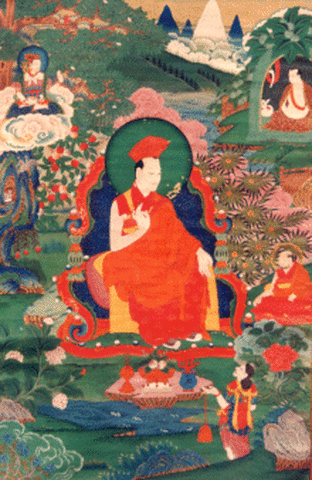 Gampopa was born in Nyal in southern Tibet to the clan known as Nyi. He was brought up and trained as a physician by his father who was in the same profession. By age 16, Gampopa was already a great physician and a knowledgeable scholar in Tantric studies. Gampopa married and had two children, but all were killed in a plague. This traumatic experience made Gampopa renounce the conventional life and enter the monastic order.
At age 25, Gampopa took the full ordination from Khenpo Lodan Sherab of Maryul. He then went to central Tibet to study the Kadampa tradition and began meditation retreat.
When he first heard the name of Milarepa, he immediately experienced an incomparable devotion and realized that Milarepa would be the destined root guru for him. Gampopa sold his farm for gold and set out to find Milarepa in western Tibet. Milarepa, who recognized Gampopa as his disciple, transmitted the entire Kagyud teachings to him. After receiving all the transmissions from Milarepa, Gampopa traveled to Dagpo to remain in meditation retreat for many years, and established the Dagla Gampo Monastery.
Gampopa was the author of many important Buddhist texts -- "The Jewel Ornament of Liberation" and "The Precious Rosary of the Excellent Path" have been two of the most popular readings up to this day. Four of Gampopa's foremost disciples founded the four main Kagyud branches, namely Karma, Phagdru, Shangpa and Darom. Phagmodrupa (Phagdru) later established the eight sub-schools of the Kagyud Order: Lingre, Drikung, Taglung, Yasang, Trophu, Shugseb, Yelba, and Martsang. Lingre was founded by Lingchen Repa, the root guru of the first Gyalwang Drukpa, Tsangpa Gyare Yeshe Dorje, founder of the Drukpa lineage.
Phagmo Drupa (1100-1170)
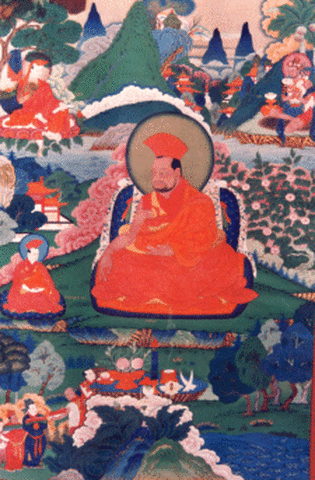 Phagmo Drupa was born in Kham in eastern Tibet into a poor family that made its living by impure means. However, Phagmo Drupa remained undisturbed amidst the family's misconduct. At the tender age of four, he took the vows of a novice monk and began his training on the spiritual path. He traveled to central Tibet to receive further training from masters residing in the vicinity.
He received intellectual and spiritual training from a series of qualified masters, including Jetsün Sakyapa who taught him the complete Lam-Dre teachings. Phagmo Drupa mastered various tantras and practiced meditation very seriously. He could remain for days in meditation, totally absorbed in the state of clarity and bliss.
Even before meeting Gampopa, Phagmo Drupa already demonstrated the qualities of an accomplished practitioner. In all his activities he exercised complete humility and fairness towards everyone, regardless of their social status and material well-being. He was particularly compassionate and understanding towards the less fortunate, and was constantly giving them his own possessions even though he did not have enough for himself. Most importantly, Phagmo Drupa was grateful to be serving all beings without exception. In practice, Phagmo Drupa spent most of his time in contemplation and meditation.
Despite his spiritual accomplishment, Phagmo Drupa still felt that he needed the guidance of a qualified master on the path. He therefore went to Dagla Gampo Monastery. Upon the sight of Gampopa and after a brief discussion with him, Phagmo Drupa immediately recognized his own wisdom mind, and fully realized the ultimate truth. Within the following days, Phagmo Drupa completely mastered the direct realization of Mahamudra.
For the remainder of his life, Phagmo Drupa continued to practice meditation with unceasing perseverance, serving as an example to others. He later founded a monastery in central Tibet, and had innumerable disciples, amongst whom his eight most accomplished disciples later established the sub-sects of the Kagyud Order. Lingchen Repa, the spiritual teacher and guide of the 1st Gyalwang Drukpa, was one of the eight disciples chosen to continue his lineage.
Lingchen Repa (1128-1188)
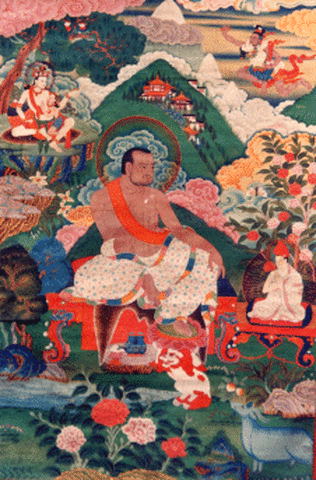 Lingchen Repa Pema Dorje, also known as Drubthob Naphupa, was born in the village of Langpo Na in the Nyang Tod district of the Tsang region in central Tibet. He was the youngest of four children born to Gyalpo Kyongwe, a Tantric practitioner, and his wife Sugmo Darchung.
By the age of nine, Lingchen Repa had mastered reading and writing. Then he offered a plot of land to Lhaje Remen and studied medicine under him. By age 13, he gained complete knowledge of medicine. At age 17, he began his spiritual education under Lopon Ling. He also received many teachings from Lopoh Palyang.
Lingchen Repa once had a dispute with one of the local chieftains and was subjected to harassment. He resorted to black magic to take revenge on the chieftain and it is said that Lingchen Repa sometimes performed 20 black magic rituals in a month. As a result, the chieftain's entire family became extinct. In those days, Lingchen Repa was renowned for his black magic powers in the whole of the Nyang Tod region.
At Rinang Mila Gompa, Nyang Tod, Lingchen Repa met Lama Shang of U and received many teachings. He also received teachings on Chakrasamvara and Vajra Varahi from Ra Lotsawa. From Lama Khyung Tsangpa, the Guru of Ra Lotsawa, he received the transmission of the teachings of Naropa. On the advice of Lama Khyung Tsangpa, Lingchen Repa became a monk and received his ordination vows from Geshe Womthangpa.
At age 37, Lingchen Repa thought he had received all the teachings and therefore decided to travel to Bhutan to contemplate and meditate. However, one night he dreamt that a man in white denuded him and inspected his body from head to toe. The man then said to him, "Don't go to Bhutan. Your wish will be fulfilled in four and a half years' time." So Lingchen Repa abandoned his plans of meditating in Bhutan.
Four years later, Lingchen Repa went to Damshod, where he heard the name of Phagmo Drupa, and decided to request Phagmo Drupa's teachings. On the sight of Phagmo Drupa, Lingchen Repa was immediately filled with devotion, and began to see not only his guru, but even his own friends and other sentient beings, as the Buddhas.
Lingchen Repa spent most of his life in solitary retreat, and because he too wore the white cotton cloth and led the life of a yogi, he was also known as "Repa". His power of mind and spiritual accomplishment gained him the reputation of "The Saraha of Tibet".
Lingchen Repa had many disciples. Tsangpa Gyare Yeshe Dorje continued Lingchen Repa's tradition, and founded the Drukpa Lineage, of which he is considered as the 1st Gyalwang Drukpa.
